Description
HIPAA, EU AI ACT, FDA SaMD | 45 CFR 164.308, 164.502(b), 164.530
HIPAA AI Governance Policy Template
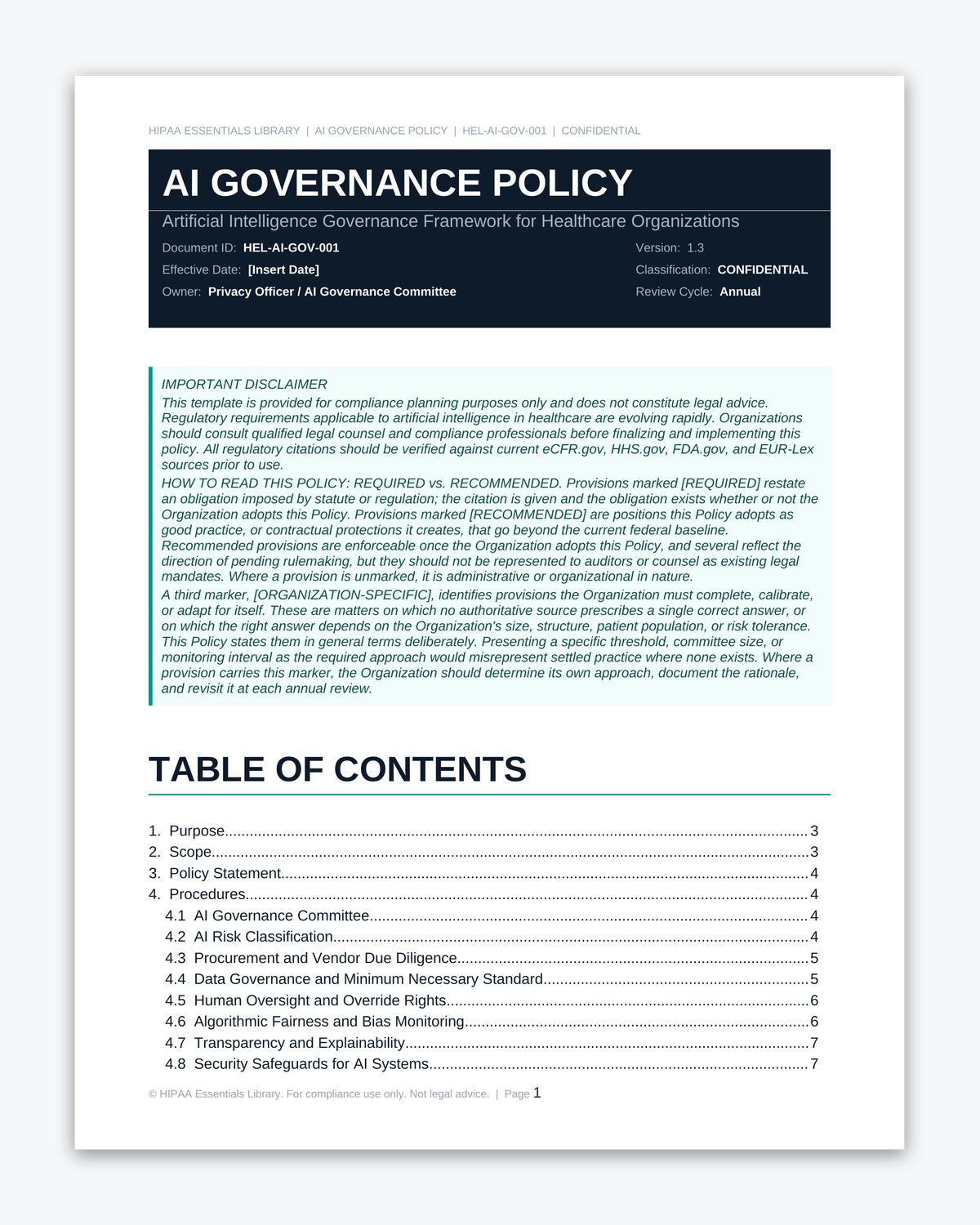
Document ID: HEL-AI-GOV-001 • Version 1.3
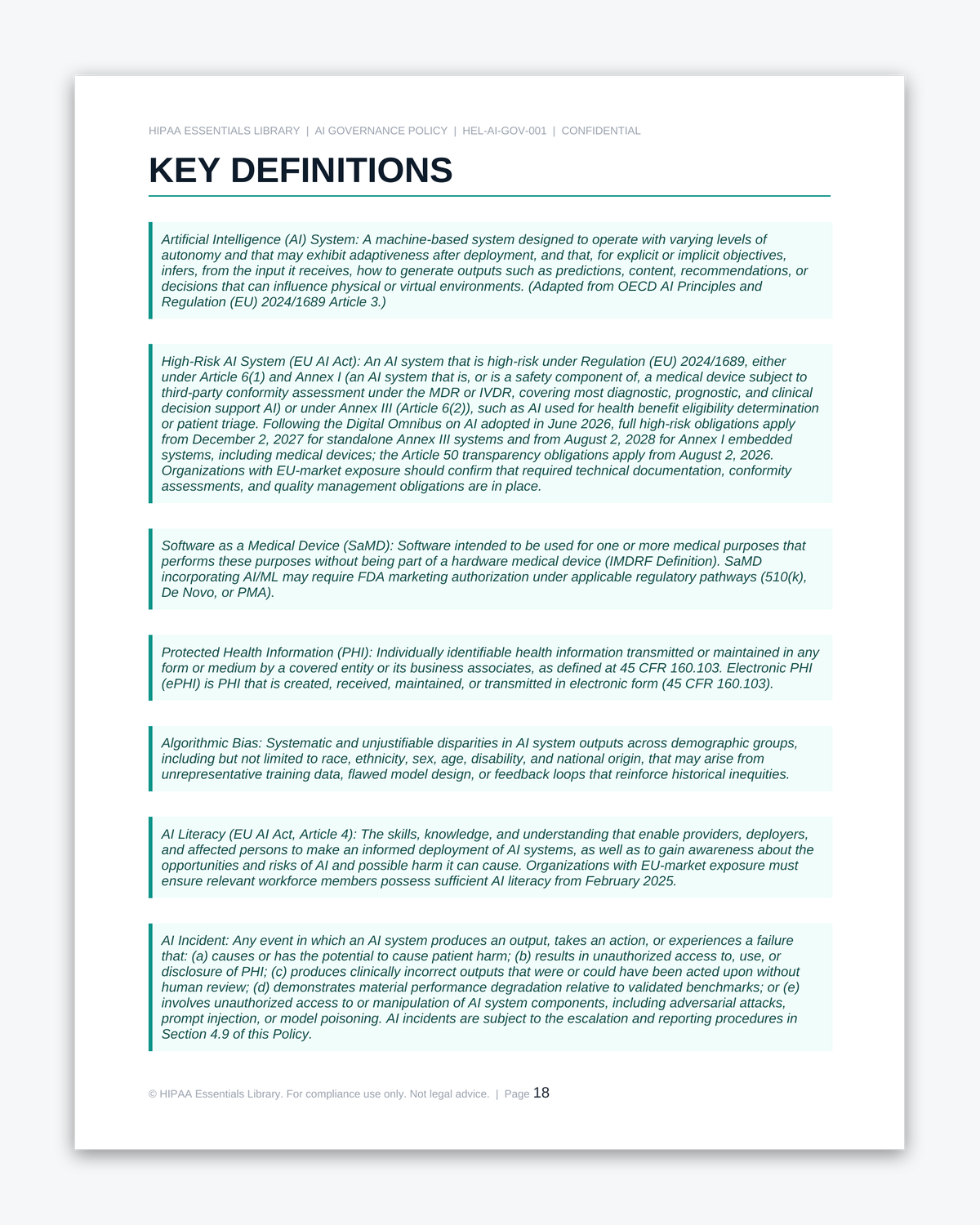
Deploying AI in a healthcare organization creates compliance obligations that a general HIPAA policy set does not address. The Security Rule requires a risk analysis that accounts for AI-specific threats (45 CFR 164.308(a)(1)(ii)(A)), the minimum necessary standard applies to AI outputs as well as inputs (45 CFR 164.502(b)), and workforce sanctions and non-retaliation protections extend to AI-related violations and reporting (45 CFR 164.530(e), (g)). State law now moves faster than HIPAA on this: the Texas Responsible AI Governance Act (HB 149) took effect January 1, 2026, Colorado’s replacement AI framework (SB 26-189) applies from January 1, 2027, California AB 3030 has required disclaimers on generative AI patient communications since January 1, 2025, and the Section 1557 patient care decision support tool obligation at 45 CFR 92.210 has been enforceable since May 1, 2025. Any AI system that influences a clinical decision may also fall under FDA Software as a Medical Device guidance, and organizations with EU exposure face high-risk obligations from December 2, 2027 under Annex III or August 2, 2028 for AI embedded in medical devices under Annex I. An organization using AI without a governing policy has no documented basis for demonstrating oversight if OCR, a plaintiff’s attorney, or an EU regulator asks how AI use is controlled.
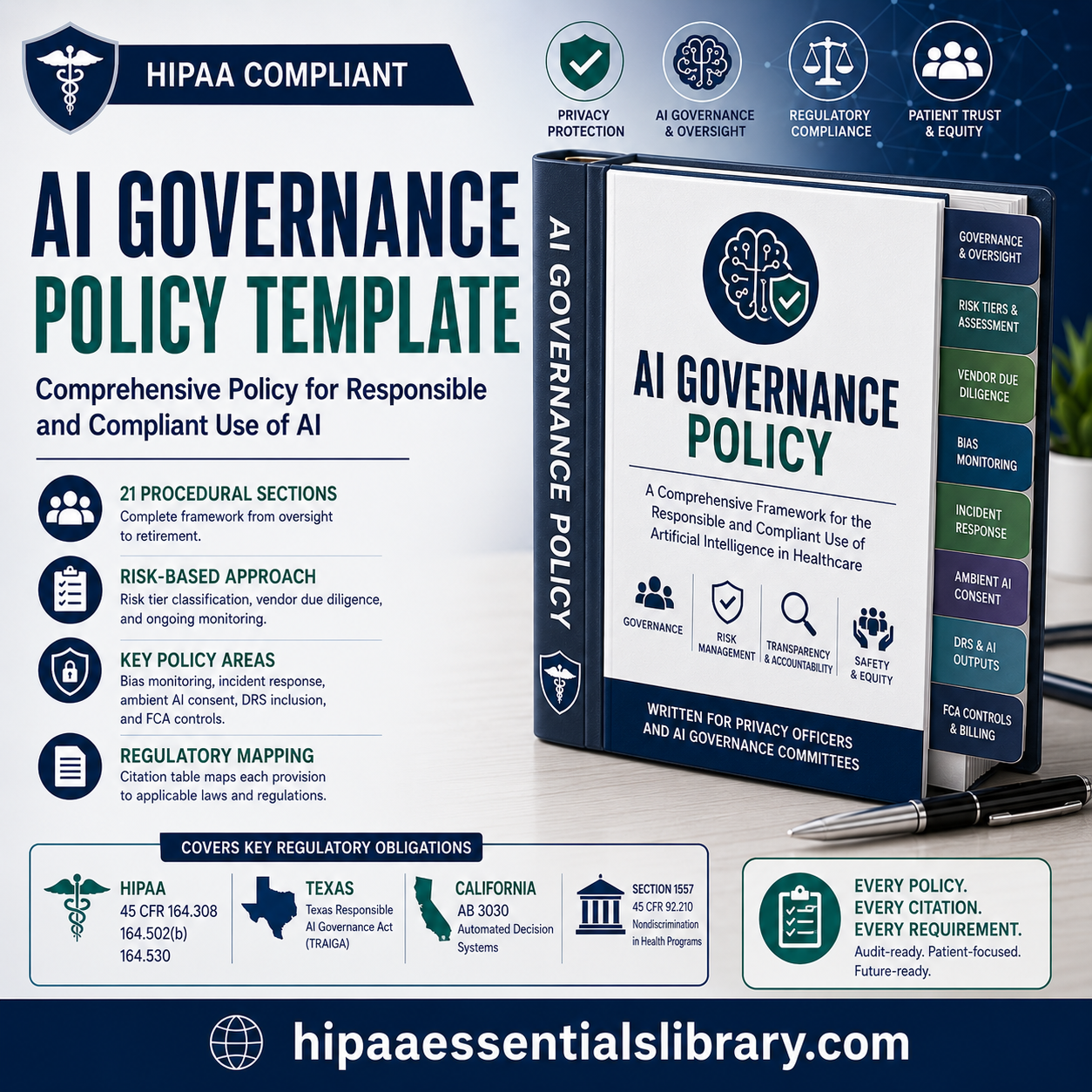
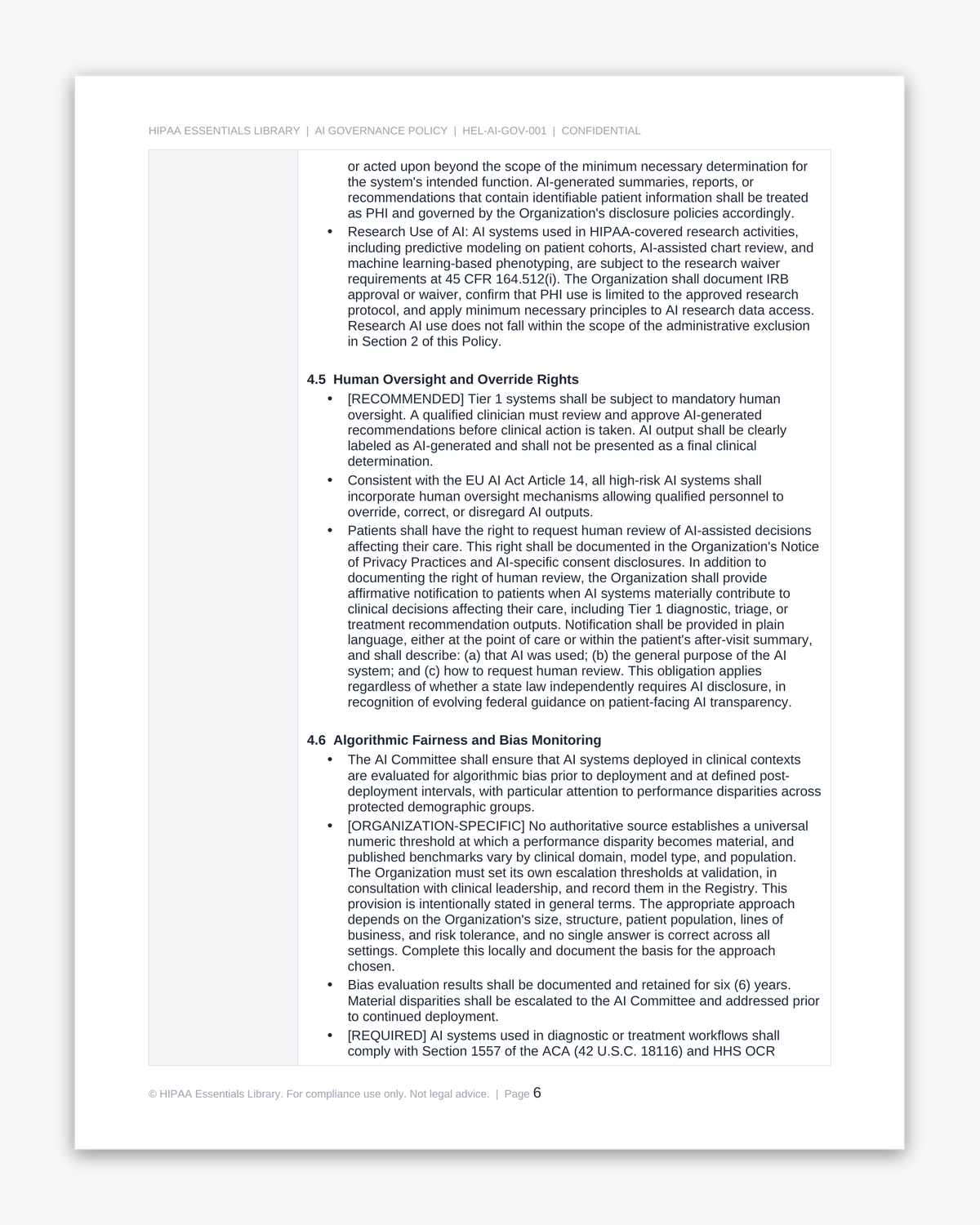
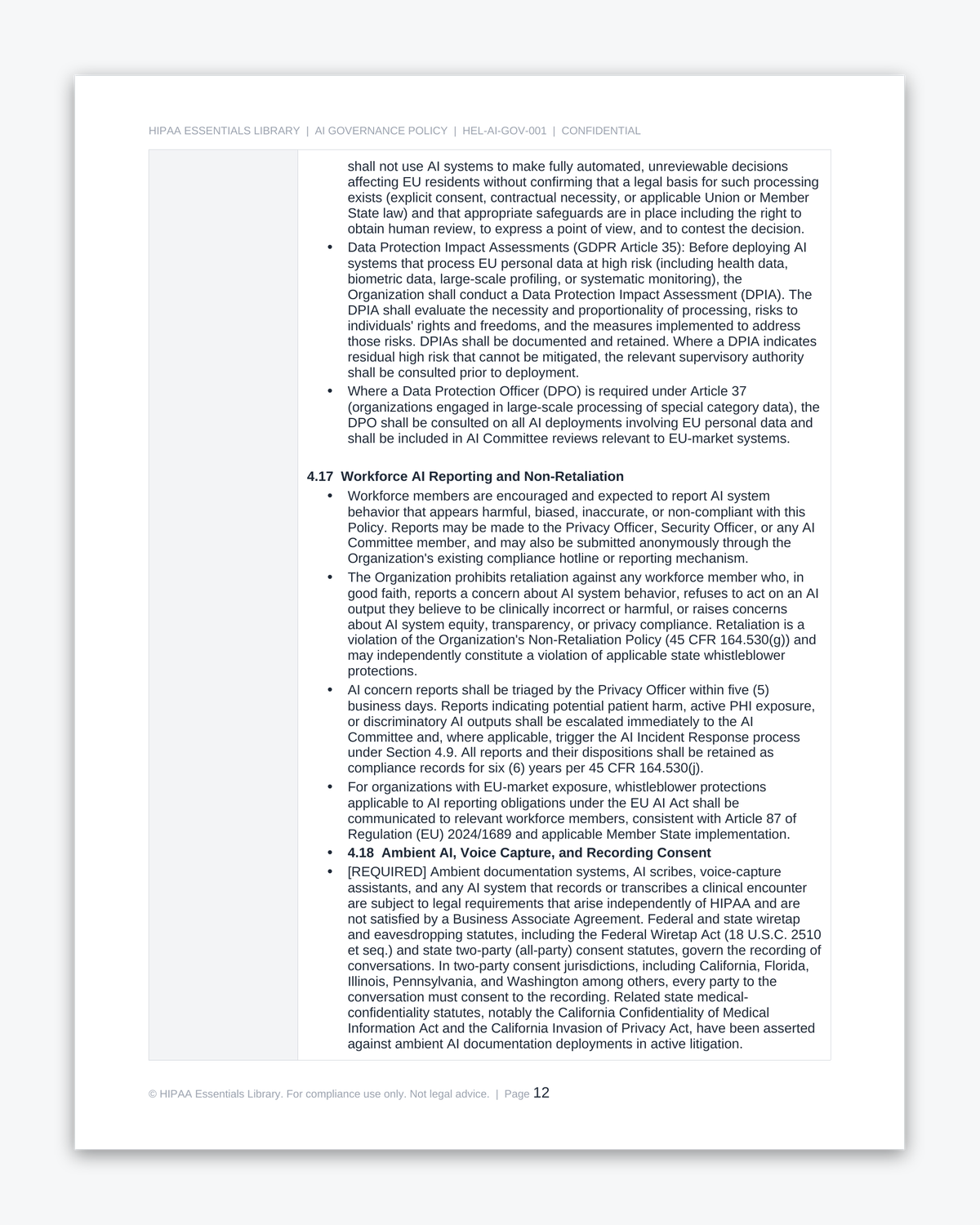
This policy builds the complete governance structure in 21 procedural sections (4.1 through 4.21): AI Governance Committee formation, a three-tier risk classification system, vendor due diligence and procurement review, data governance and minimum necessary controls, human oversight and override rights, algorithmic fairness and bias monitoring, transparency and explainability obligations, AI-specific security safeguards, incident response, a consumer and unauthorized generative AI tool policy, system retirement and decommissioning, model change management and version control, OIG and False Claims Act exposure for AI-assisted billing, an ethics review process separate from technical risk assessment, state law preemption analysis, GDPR automated decision-making and DPIA requirements, workforce reporting with non-retaliation protections, ambient AI and voice capture recording consent, treatment of AI outputs within the designated record set and the individual rights that follow, AI in coverage and utilization management determinations, and patient safety event reporting aligned to external guidance. The policy framework table, decision checkpoints, records schedule, training requirements, and a regulatory reference table mapping each provision to its statutory source are included for audit documentation.
What Is Included
Governance Framework
- AI Governance Committee structure and three-tier AI risk classification system
- Vendor due diligence and procurement review procedures
- Data governance and minimum necessary controls for AI inputs and outputs (45 CFR 164.502(b))
- Human oversight, override rights, and algorithmic fairness and bias monitoring procedures
Compliance and Risk Controls
- AI-specific security safeguards and incident response procedures
- Consumer and unauthorized generative AI tool policy with sanctions provisions
- System retirement, decommissioning, and model change management with version control
- OIG and False Claims Act risk controls for AI-assisted billing
Documentation and Multi-Framework Compliance
- AI ethics review process and state law preemption analysis
- GDPR automated decision-making and Data Protection Impact Assessment procedures
- Workforce AI reporting and non-retaliation protections
- Ambient AI, voice capture, and recording consent, including the state all-party consent determination
- AI outputs in the designated record set and the resulting access and amendment rights (45 CFR 164.501, 164.524, 164.526)
- AI in coverage, utilization management, and payment determinations, and patient safety event reporting
- Policy framework table, decision checkpoints, records, training, and regulatory reference table
Who This Is For
Privacy officers, security officers, and compliance leaders at hospitals, health systems, and medical practices standing up an enterprise AI governance program for the first time, or updating an existing program to address the Texas Responsible AI Governance Act, Colorado’s 2027 AI framework, or the Section 1557 decision support tool requirement. Also built for AI governance committee members who need a single governing document to reference during vendor evaluation, incident response, or an OCR or EU regulatory inquiry.
This policy is not operational until adopted by leadership, populated with organization-specific committee membership and risk tier assignments, and integrated with the AI Governance Committee Charter (HEL-AI-CHARTER-001), AI Intake and Governance Review Request Form (HEL-AI-INTAKE-001), AI-Specific BAA Addendum (HEL-AI-BAA-001), and AI Incident Response Addendum (HEL-AI-INC-001).
Format: Microsoft Word (.docx), fully editable • Delivered as an instant digital download • Document ID: HEL-AI-GOV-001


Reviews
There are no reviews yet.