Description
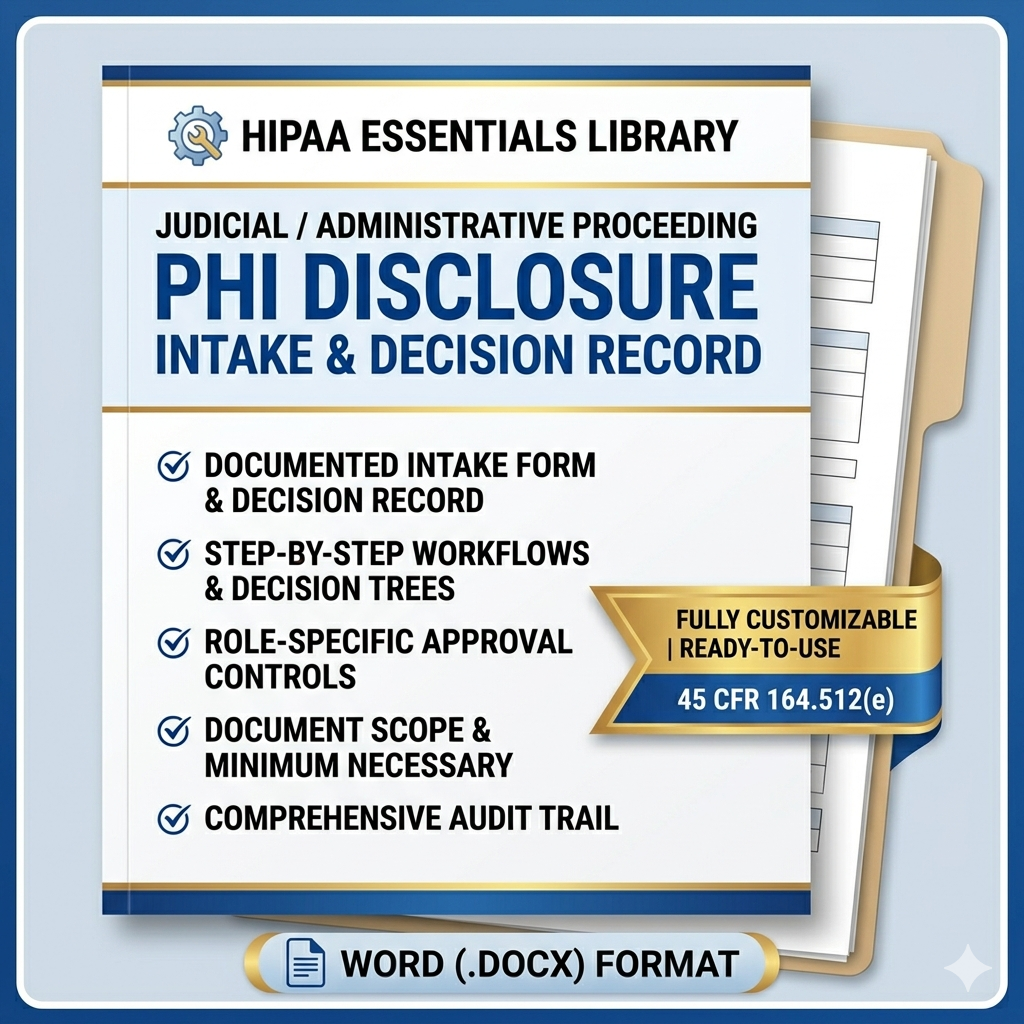
Judicial / Administrative Proceeding PHI Disclosure Intake and Decision Record
A structured intake form and decision record for documenting PHI disclosures in response to court orders, subpoenas, discovery requests, and administrative demands – with branching decision checkpoints, scope-of-disclosure documentation, and role-specific approval controls.
Legal process requesting PHI is one of the most operationally complex disclosure scenarios a covered entity faces. The disclosure pathway depends on the type of legal instrument received – and getting it wrong creates both HIPAA exposure and legal risk. This template provides a complete intake and decision record for documenting the full response lifecycle: from receiving and verifying the request through evaluating the applicable disclosure pathway, applying minimum necessary, documenting the disclosure event, and obtaining role-specific approvals for escalated or non-routine matters.
What This Template Covers
- Request summary and timeline – request/case ID, date received, response deadline, date of decision, requesting party, matter type (civil, criminal, administrative), method received, organization role, affected record set, authenticity verification, and legal sufficiency determination
- Legal process type and branching logic – court order, subpoena, discovery request, administrative request/demand; issuing authority, jurisdiction, and docket/case number; branching notes for each request type with escalation triggers for mixed or unclear requests
- Decision checkpoints – whether a court order is present; whether a valid individual authorization covers the disclosure; whether satisfactory assurances (notice to individual or qualified protective order) were provided; whether administrative request criteria are met; and whether specially protected information is involved (psychotherapy notes, HIV/behavioral health, 42 CFR Part 2, minors, contractual limits)
- Minimum necessary and scope of disclosure – requested PHI description, PHI approved for disclosure, scope determination (minimum necessary analysis, court order/legal instrument, or other documented basis), and evidence for scope limitation
- Disclosure event details – date and time, method, recipient name and contact, tracking number, secure transmission confirmation, accounting of disclosures requirement and logging status, disposition and outcome, and protective terms or scope negotiations
- Attachments and evidence checklist – legal process copy, identity and authority verification, authorization or no-authorization documentation, decision memo or legal/privacy review, and business associate communications
- Role-specific approvals block – preparer, Legal/Privacy reviewer (required for escalated matters), and approver (required for escalated, non-routine, specially protected, denied, or deferred matters)
- Regulatory references – 45 CFR 164.512(e), 164.502(b), 164.514(d), 164.528, and 164.508
Who This Is For
Privacy Officers, Health Information Management staff, Compliance Officers, and Legal teams at covered entities that receive legal process requesting patient records or other PHI. Suited for health systems, hospitals, physician practices, health plans, and any organization that needs a consistent, documented process for evaluating and responding to court orders, subpoenas, discovery requests, and administrative demands – including those involving specially protected information categories.
Regulatory Context
Under 45 CFR 164.512(e), a covered entity may disclose PHI in response to judicial and administrative proceedings, but only under specific conditions that vary depending on whether a court order is present, whether the individual has authorized the disclosure, and whether satisfactory assurances have been provided. The minimum necessary standard applies to all permitted disclosures under 45 CFR 164.502(b) and 164.514(d). Disclosures pursuant to legal process may also be subject to accounting requirements under 45 CFR 164.528. This template creates a written record of the full decision process – documenting which pathway was used, what PHI was released, who authorized the disclosure, and what evidence was reviewed – suitable for retention in an audit file or production in an OCR inquiry.

Reviews
There are no reviews yet.